
We bought our first home last year.
And while the house itself is no bigger than the one we were living in before, it’s still an upgrade. And even though it needs just as much work (or more) as the house we were living in before, it’s still an upgrade. And despite the fact it costs more than the house we were living in before… it’s still an upgrade, right?!
Just kidding. We love our new place. And yeah, a year in and it still feels new.
The house itself though is pretty old. Well, by American years… I have work friends on the other side of the world who live in homes older than our constitution.
But here, ours is considered a “century home” because as the name suggests, it’s more than 100 years old. It’s an old farmhouse/cottage (I haven’t decided yet what I’m going to call it 😉 ) that sits on three and a half acres with woods and a pond. Circa 1910 or so, the house began as a single square room with a wood stove and a bedroom. Future occupants tripled its size by adding on a new kitchen, additional rooms, and other conversions that make it the cozy home it is today.
I’m actually not even sure it started as a “home” in the first place. And the original hitching post outside might suggest that, too.
The Trolley Line
Because, as we discovered when buying the place, an old trolley line used to run through our property and made a stop here. It ran from a former opera house downtown (now a trendy restaurant) to the coal mining camp outside of town, not far from where we are now.
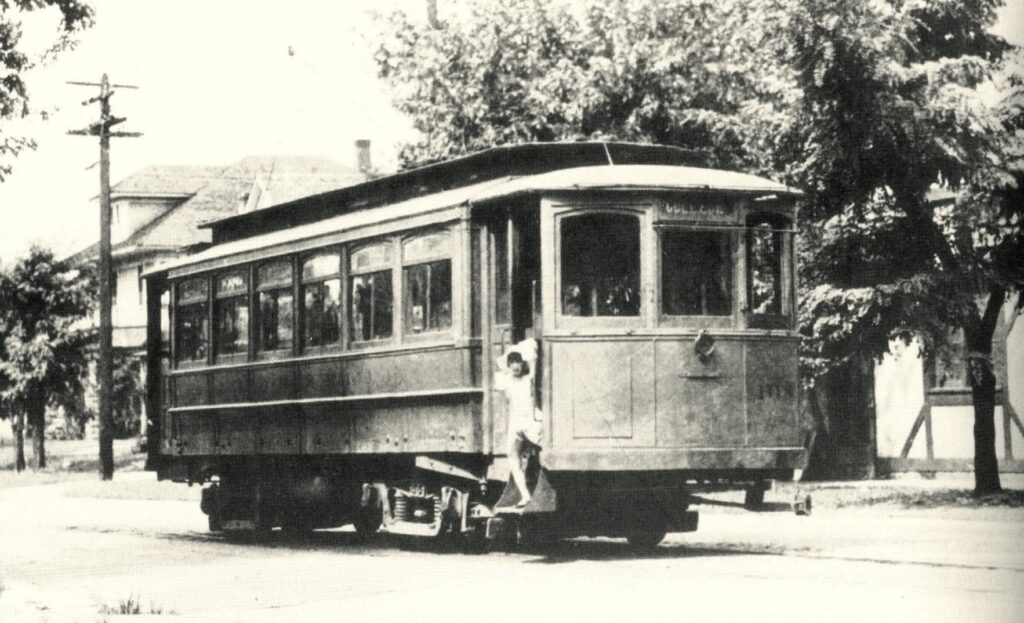
I’ve been doing some research about it and learning the fascinating history.
What started as a trolley line in the early 1900s, connecting coal mining camps to the larger municipality, grew to rail lines that eventually became part of the Kansas City Southern Railway, the Santa Fe Railroad, the Frisco Railroad, and others. By its 1915 heyday, the railway line headquartered here connected 25 surrounding towns and cities, had round trips that lasted a full day hitting each stop, and provided both freight and passenger service.
While this transportation was mostly for the coal mining business, many rural families took the trolley into town to do their shopping.
However, there’s little left of the trolley lines. Operations were fully ceased by the 1950s, and the land on either side of the tracks was divided out. Which actually created a huge issue for us when buying this property 70 years later… Because apparently, the property had just like, never been surveyed before? At least not since before the railways were being established here in the 1870s.
So when the line cut through this land a hundred-some years ago and then later transferred ownership, it’s like the deals were sealed with a handshake and a spit in the dirt. Our surveyors were calling up local businesses and looking at hand-drawn maps from the 1800s. They told us ours was the largest file they’ve every compiled. It actually ended up being a really cool historical experience for everyone involved.
To make a long story short, all of us — the homebuyers, the sellers, the realtors — held our breath while the survey company did their diligence and configuring, days before we were set to close.
Spoiler alert: It all worked out in the end, obviously. 😉
Where the Grass is Greener
The former line is now just a raised trail in the woods outside our house that we love to walk along. Otherwise, there isn’t much evidence of any trolleys. Except for the occasional artifact that washes up from who knows where after a heavy rain.
It’s actually kind of interesting to think about. The earth just swallows things right up with the rain, but then also spits them back out again when it wants. I see it happen out here all the time.
And since being here, there’s been A LOT of rain. So much rain that our pond is consistently full thanks to a couple of strong streams that flow down into it. At its fullest, the whole thing is about as long as a football field, with little streams and offshoots.
So we float around in our kayak surrounded by trees and I pretend like we’re in the marshes of The Notebook or Where the Crawdads Sing.
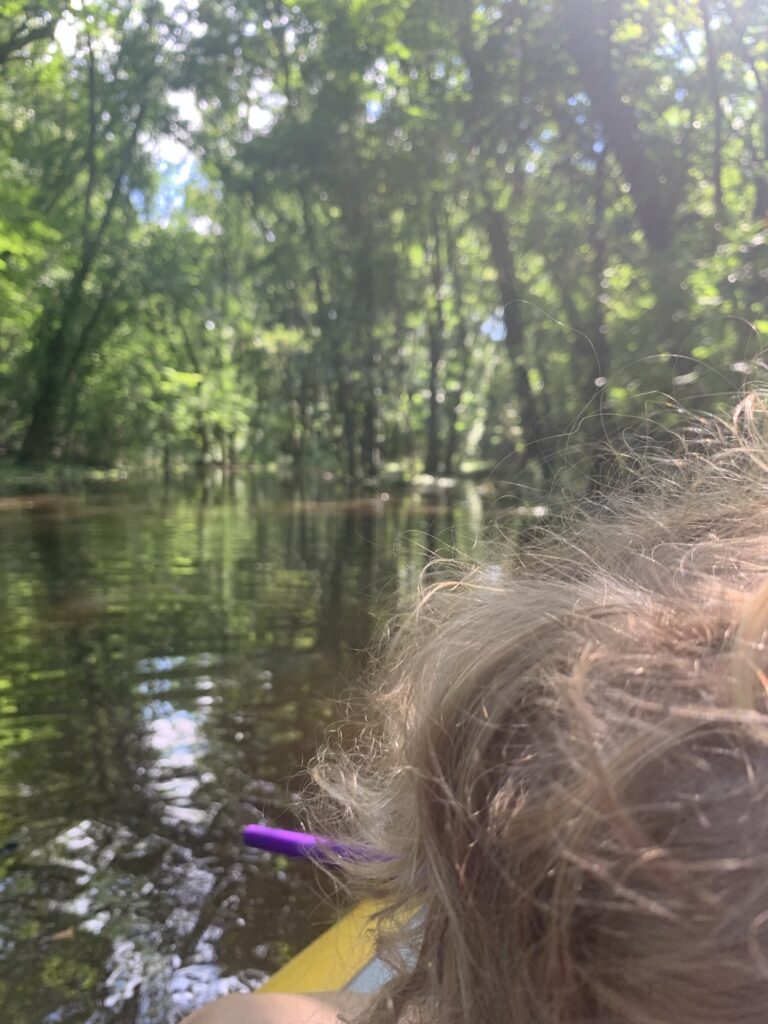
And a lot of times, this is exactly the greenery and lushness that I miss after a long time in the arid conditions of our Colorado camp land.
Our property in Alamosa where we spend months at a time in our RV has virtually zero trees and minimal grass. Winters are long, the environment can be rough, and I found myself actually missing the midwest when we were on our land one April in the slushy snow, knowing that the full green spring was already blooming back home in Missouri.
All that to say, the landscape can be both beautiful and harsh, just like it can be here or there or pretty much anywhere. So, grass is greener and what have you.
No, we didn’t buy a house in the Colorado Rockies like previous versions of ourselves imagined we would… But we bought one where our daughter can see her grandparents every day if she wants. And I distinctly know the words “I’ll just never do the humidity again” have come out of my mouth in the past when talking about the area I once again call home. But I get the nuance now, I hope.
I know that the luscious green grass I like to walk in barefooted and the warm stormy season that starts early in the year and the — let’s be absolutely real about this — more affordable cost of living and home ownership comes with lower elevation and higher humidity.
Like that’s literally what makes the grass greener. It’s just all the damn humidity.
Plus I’m like, reeeeeally good at romanticizing those Rocky Mountain elements. For example: We love to go camping in Winter Park, Colorado. In the summer, mountain snow melts and flows into little streams all around the town and campsites. The water is clear, cold, and probably even drinkable. I’m easily charmed by ye olde babbling-brook, and it’s one of my favorite parts of mountain camping in the summer.
So imagine my delight to discover our own little stream system that flows down a tiny hill and feeds rainwater into our pond. The shallow water is clear, fast-moving, and charming. Would I drink this water? HELL NO. But I can put my toes in and close my eyes and listen to the water.
And I’ll think the same thoughts and have the same meditations and come to the same conclusions here as I would in a Colorado mountain stream or in my own bathtub — wherever that is. Because the grass is always greener where you water it.
Til the next one,
xoxo, Kacie